Behind the Brand: Getting Under the Skin of Supermood’s Holistic Approach

Supermood is a holistic natural beauty brand from Finland, founded by Anne and Joni Kukkohovi, a charismatic duo and life partners. Both have background working in advertising and were settled in the bustling media industry until a few years back, when Anne, a former model and current TV host, was bidding adieu to her rewarding career, to set a base for something more close to heart — beauty with holistic approach. 

Anne’s Nordic, but uncharacteristically lively character is a measured yin to Joni’s soft-spoken, calculated yang, whereas the couple is a living proof to the statement 'team work makes the dream work'. The duo essentially represents the core values of its brand — as I should know first-hand, being Scandinavian calls for a reserved, demure nature, which they bring to the table with an unusual, whimsical twist. 

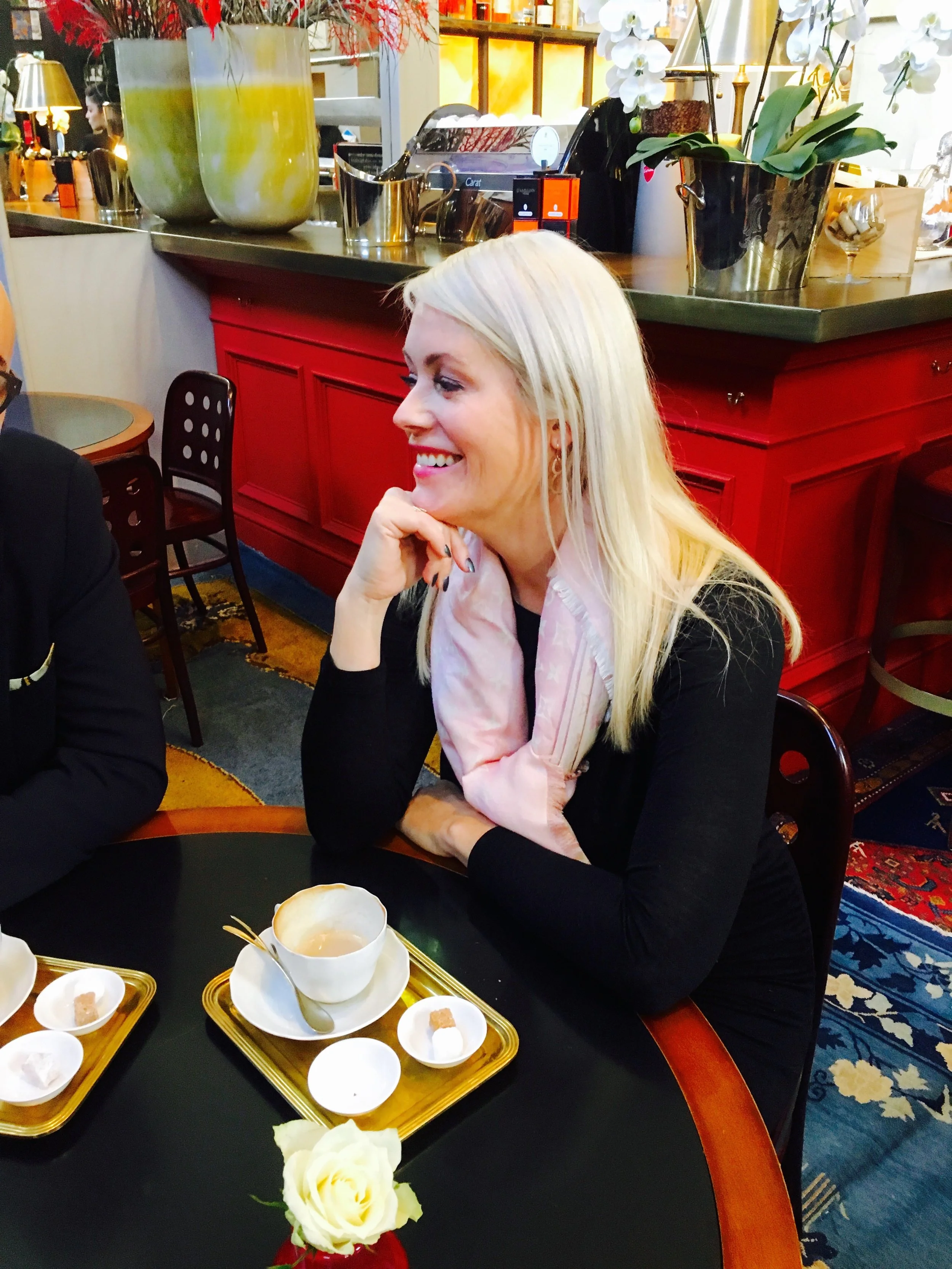
I shared a friendly coffee and a chat with the couple at Maison Assouline, my favourite secret hideaway in London, and explored the way they think — although the duo still adamantly insists I avoid the O-word — organic beauty and its role in the cosmetics industry today… 

Egoboost: 'Inner Beauty' smoothie with nutritional supplement powder of Chaga and collagen.

Egoboost: 'Inner Beauty' smoothie with nutritional supplement powder of Chaga and collagen.

Anne (A), what’s your personal relationship with the beauty industry?

I’ve been breathing fashion and beauty since I was a teenager. First time, I was 12 and I saw ELLE magazine, that’s where it hit me. For years, I was a well-know model in Finland, and then I got into the advertising business. I have also been working as a TV host for many famous shows, such as ‘Finland’s Next Top Model’, and I’ve been an ambassador for different beauty brands before. Supermood is where everything combines — the communication, art direction, and my passion for beauty. I always knew I wanted to have my own brand at some point. 

Joni (J), what does your role as a Marketing Director at Supermood incorporate?

First of all, we are married, so it’s a family affair! We both have a background in advertising and we also met through the industry. Then, we worked at the same agency for a while, which wasn’t such a great idea. Soon after, Anne decided to go for the entrepreneur route. She is taking care of the product concepts and the vision of the brand, and understanding of what sort of beauty trends there are, and how to approach it. Therefore, my job is to interpret her vision and then execute, so I am in charge of the branding and marketing, but I still do work as a ECD (Executive Creative Director) at an advertising agency.

You started in 2014 from scratch.

Both nod in agreement. 

J: I think one of the things that really helped is our agency background in advertising. You’re used to story-telling, you have an idea [of what you want to produce], and then you just have to find the right people, brief them and direct the final outcome.

Joni and Anne Kukkohovi, founders of Supermood.  

Joni and Anne Kukkohovi, founders of Supermood.  

How does the whole process work with product concepts?

J: Firstly, Anne briefs the chemist at the factory, with some references and desired ingredients. Then what follows is that our chemists make samples and she gives feedback — this is too rich, too heavy, too intense, and so forth and so forth. The testing and trial-and-error lasts 4-6 rounds, until you find that product you’ve imagined. 

A: For me it is important that they understand, how I want the products to feel, what are the ingredients, expected texture, and time it takes to show effects. They also ask, if we want to have a long INCI (ingredient) list. Of course not, because the cosmetics we are doing are very pure and transparent, so we try to avoid anything extra.

The direction you have chosen with Supermood is (excuse me for the categorisation) organic or green beauty. How does it resonate with our cultural climate and the current beauty industry trends?

A: This is the present and future already ingrained in any other field, it’s in cars, in textiles, in design— it’s everywhere — so I don’t even emphasise the green aspect so much.

J: People often ask, what’s the one thing that sets us apart, but it’s never just that, it’s more about our approach to beauty. It’s not about some compound or secret ingredient. We wanted to build a brand for women who love prestige brands, and are accustomed to using premium luxury brands, but are conscious about green beauty and also the fact that most of the established beauty brands are synthetic. 

A: Unfortunately, there was not any kind of alternative for these women at the time, because most of the green beauty looks to be kind of home-made to an extent.

How do you see the industry change in the future?

J: We feel that in 10 years, it’s not about green beauty, it’s about just beauty. We have to be something else as a brand, not just organic beauty.

A:  The way we see it, in 10 years, all production will have a greener approach and a more conscious impact. What we do emphasise on, is the holistic approach.

Could you elaborate on the concept of ‘holistic beauty’?

A: Holistic beauty means that you have edible things, then we have a range of ‘therapeutic’ products, we aim to bring together a ‘holistic triangle’ of beauty, so it’s not merely one-dimensional. The world around us inspired us for such approach — you see people and they want to eat well and they want to take care of themselves in a 360-degree way. 

J: In the beginning it is about your skincare — what kind of things you put on your skin, whether it is artificial or organic, what gets into your system. That’s one part. Then it is about the edibles, what you put into your body as nutrition. Then the last part is, how do you sleep, how do you give your body time to recover. 

Beauty Sleep: youth restoring night cream. 

Beauty Sleep: youth restoring night cream. 

So that’s the holistic, conceptual approach. I saw a pillow in your range and then the moist for it…what’s the beauty pillow about?

A, J: This is also a part of the therapeutic aspect of the ‘holy triangle of beauty’, which comes with a scent for the pillow or bed linen. 

A: Coming up with product concepts doesn’t need to be always led by one way of thinking — calming herbs and florals, they have been used for years and years, but you wouldn’t think of featuring a pillow in a beauty range. 

What inspired you?

A: The idea came, when we were once staying at a hotel with huge and, by what they looked like, comfortable pillows, but when I woke up, I had deep ‘pillow lines’  (Anne illustrates theatrically, with bold gestures) all over my face. So the pillow I invented helps to avoid those lines and doesn’t give you any puffiness at all. When you think about it, you spend one third of your life in bed, so it is crucial to have special beauty equipment for bedtime. 

J: We got the idea when we read about this surgeon, who developed a pillow for post-surgery patients. Obviously when you’ve had something done, you cannot sleep on a regular pillow, because otherwise your face will become disfigured. He had designed this kind of pillow that distributes the pressure differently; it doesn’t impact on your face, or leave any lines on your face, as it does with your regular pillow. It was based on a study about how blood circulation goes into your face.

Who is the buyer the pillow is meant for? 

A: These niche items are for ‘beautyholics’, like me. I can make out the kind of people by looking in their eyes, sometimes they just grab the pillow and they don’t even talk to me, and then the others ask, ‘Why would you do this?’, and I would think, maybe it’s not exactly for you. 

"We aim to bring together a ‘holistic triangle’ of beauty, so it’s not merely one-dimensional. The world around us inspired us for such approach — you see people and they want to eat well and they want to take care of themselves in a 360-degree way." 

Who is that person who lives and breathes Supermood?

A: It is somebody who is in the radar of the new things, takes care of themselves; someone who is conscious about the natural environment and wants to do something about it, but also wants to look good and wants to look fashionable at the same time. I call it like the ‘W Hotel and Wholefoods person, or Net-A-Porter user, so this person is present all over the world. It’s not about age. It’s not about what ethnicity you represent. It’s not about where you live. It’s more about the way you think about things. 

When it comes to working with your partner… do you experience any creative clashes at all?

J: Constantly!

A: It hasn’t always been easy, to be honest. But I think the vision we have is the same. We are a young brand, so it always comes down to those big decisions and projects. But vision-wise we don’t have so many differences —

J: Artistic differences! 

A: But it’s more about, how to use time more efficiently and find the right deals. 

J: We are both hands-on engaged in our other projects, like TV and advertising, so time is our biggest challenge. When we do have a lot on the table, we always consider all the options and priorities. Often Anne says adamantly, ‘this is more important, and we have to go forward with it!’. They’re not exactly arguments, but a way of making out what’s actually important. 

And what saves you in those moments?

A: We are really passionate about the whole thing.

Meanwhile Anne tells a story about presenting to a bunch of male investors in a fancy, formal setting, whereas Anne, keeping her enthusiastic spirit, had invested a great deal of inner passion in storytelling. The reaction was the men going, ‘It’s just a beauty brand. Why are you so passionate about it?’, whilst Anne lost her temper explaining the passion comes from the fact that it’s her vision, and she has invested a lot of time and energy in it, ‘Of course I am passionate about it,’ Anne tells full of spark.
What brought you to London?

A: We are going to have a Space N K launch in December, which will be our biggest UK distributor. It’s a huge thing for us, as you have all the best boutique brands in there, so we are exploring the possibilities of publicising the launch and PR with them.

J: Other markets that we’ve been working with so far have had an incredible response. We are hoping that UK follows the same route, because it is such a big and important market. It is a priority for us to break through here. 

Anne boasts such a radiant, youthful glow that I unapologetically turn to her, asking whether she uses her own products. Her confident smile reveals there shouldn’t be a degree of doubt.

What’s the absolute must-have product from your range?

A: 1-minute facelift. It’s one of our key products, although we think that there is no one main product on the importance scale. It does exactly what it says effectively — it really tightens your face and skin up. We also sell it in the States.

J: It’s the most effective sculpting and lifting serum, which also happens to be everyone’s favourite. 

Egoboost: 1-minute facelift serum with Chaga. 

Egoboost: 1-minute facelift serum with Chaga. 

A: We also have an eye serum, ‘Eyes Wide Open’. [To illustrate its effectiveness], first showing it to Joni, I put it on one eye and I said, ’compare it to my other eye’, — he is really suspicious about everything — and he said: ‘It’s really bigger than the other one!’. So it is very effective. For that we used a local Finnish ingredient called Chaga [immune-boosting medicinal mushroom]. That’s one of the main ingredients we use. 

J: We do all the testing with Anne. As she said, I am fairly suspicious about claims of products. When we started, I wasn’t a big believer in organic cosmetics, so I told her strictly that it is adamant that our products are effective, it is not enough that we do great branding. That was like the first penny drop for me.

A: It’s still very few people, who want everything to be super clean, without any extra additives. We are not aiming for that, but the actual effectiveness. 

Egoboost: 'Eyes Wide Open' firming serum for the eye area. 

Egoboost: 'Eyes Wide Open' firming serum for the eye area. 

Where do you produce?

A: We found a local Finnish factory — despite exploring opportunities as far as up to Italy — but I wanted it to be closer to me to learn, too. They are the first Eco-Certified factory in Finland, so they know about that sort of [organic] cosmetics. 

It is, of course, very difficult to get those 100% pure components. Where do the ingredients come from?

A: Chaga comes from a city called Kauhava in Finland, and it is handpicked. The other ingredients are the produce of organic farming in different places around the world. It does depend on the climate a lot — when you have monsoon rain somewhere, it might affect some ingredients. They cannot assure the stability of the supply country, but therefore they make sure it at least feels the same. 

J: Chaga is basically forged — it grows wild on the trees and that’s the main reason why products with it cannot get eco-certified, because it’s not controlled by any agency, so it remains the type of product that you cannot classify as ‘certified or organic’, even though, in theory, it is found in its purest form. The EU legislation hasn’t quite figured it out, whether its a pharmaceutical, but through clinical tests it has been proven to be super effective.

A: Chaga has been used in folk medicine for thousands of years and also in Eastern countries, because it makes your skin really even. Also, when you consume it, it is really good for your immune system. It has a very strong effect — say, when you are taking antibiotics, then I would recommend using or consuming it. 
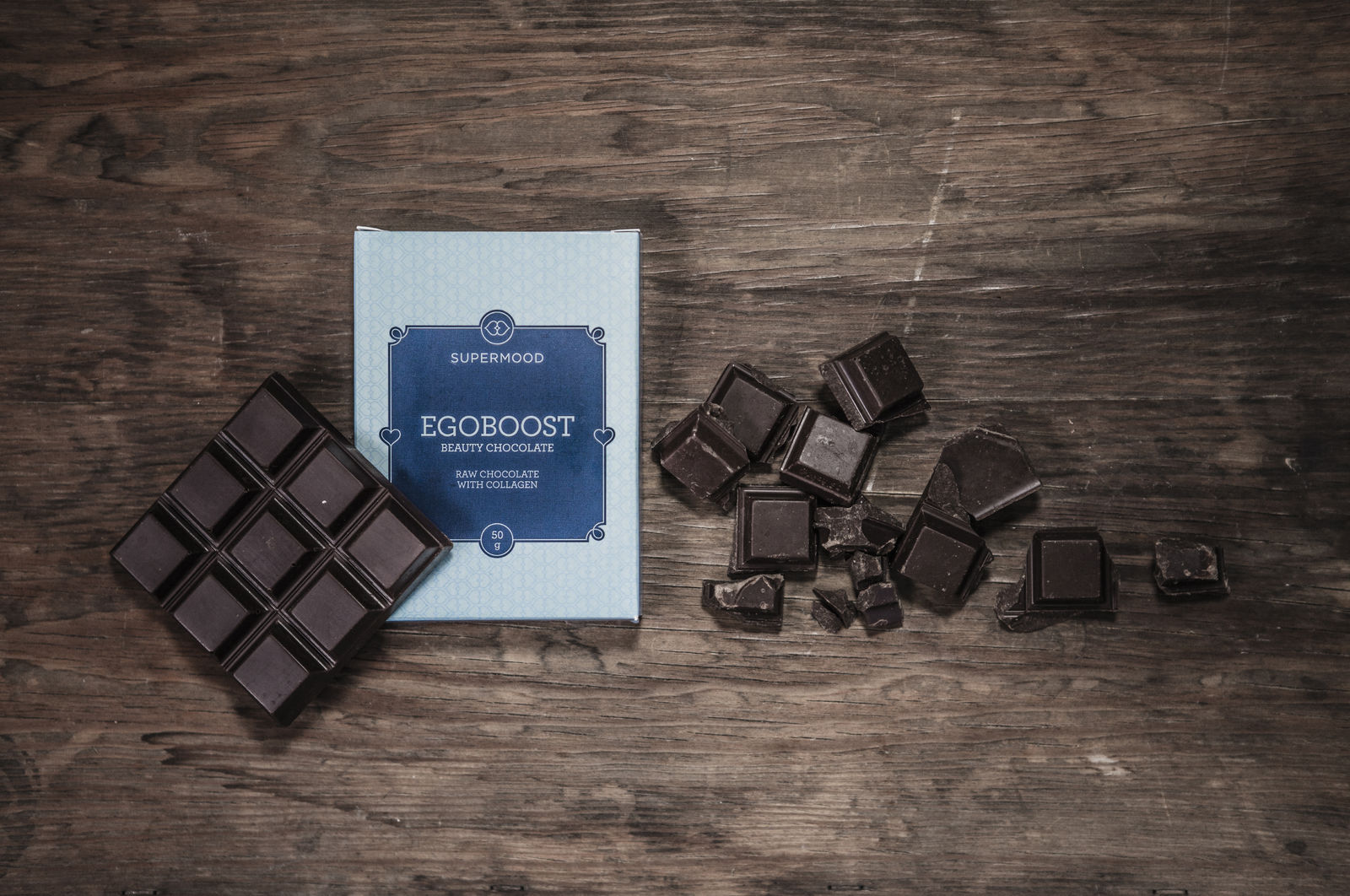
Egoboost: 'Beauty Chocolate', raw chocolate with collagen.  

Egoboost: 'Beauty Chocolate', raw chocolate with collagen.  

J: We feature it in some of the skincare products — we have a collagen and Chaga powder, which is a nutritional supplement that you can blend into your milkshake or smoothies, and also with collagen we have beauty chocolate, which is a raw chocolate.

I saw it! Yes, it is the most interesting product. What’s it about?

A: Everybody says that. Whispers to Joni, ‘now you hear it’. 

Laughter. Anne, it was your idea, of course. 

A: It’s raw chocolate, so we are not talking about organic chocolate, which is heated up. Raw chocolate is cold-pressed, and it’s really expensive to produce. Often the issue is that the price and quality of cocoa varies seasonally. 

J: When it comes to chocolate or coffee, it reacts to weather changes, which right away affects the price of chocolate. A lot of things are very expensive to produce, because you cannot have such volumes, where you could leverage the buying power. That’s why green beauty, as well as green fashion, is still highly priced. 

"Brands have to evolve over time, but at the moment, I think the more layers and perspective you have as a brand, it becomes actually more interesting rather than having this Bauhaus-aesthetic approach."

In today’s visual culture, branding is very important. Advertising background and knowing you target audience well surely works in your favour…

A: People usually want to categorise into either ‘organic’ or ‘normal’, meaning synthetic cosmetics category. We are organic, but that is secondary. On the ferries that are going between Finland and Estonia, they’ve put us next to Dior. That’s exactly the perfect way to explain it, ‘just place it where the good brands are’.

J: It is less to do with the fact that it is green and more to do with communication and how we build the story and tell it, but it doesn’t have to scream ‘green’ at the display. It has to look nice on your bathroom shelf or nightstand. It has to fit in with your other luxury cosmetics.

I have even gone for some beauty stuff only for the packaging, then found out later, ‘oh, it’s 98% bio-organic, too’. 

A: I remember one retailer telling me ‘I don’t care what’s in it, I take it!’, when they saw those pictures of what Joni did — illustrative mockup in 3D of all the range.

J: The first question is, ‘Is it appealing?’, when you see it in the store. Then the next question is, if it something that I would actually use for its utility.

Youth Glo: luxury peel with AHA acids and fruit extracts.

Youth Glo: luxury peel with AHA acids and fruit extracts.

I am totally in love with the packaging!

J: The appearance is a bit whimsical, we felt that green beauty is often strictly about the environment, using green hues. With such personal product that should reflect the user’s values, we wanted to give ourselves that permission to be funny. 

A: [It is] a little bit bold. Also flirty, because when you see all those lines that we have hidden in the packaging — if you find them, you find them. Those little messages. 

J: If we would have chosen kind of a minimalistic and clean, too rigid, approach, I am not sure that would be as much fun to do, it just wouldn’t be entirely ‘us’. If we don’t get that first reaction that it looks good, then it’s a lost case. 

There is this standard Scandinavian minimalism style and approach. Are these the end days?

A: There are so many brands doing this, so it’s already too repetitive. 

J: I think this [Maison Assouline] coffee shop is a good concept — the new and the old meets. The age of ultra design and ultra clean is getting old, in my opinion. In that sense, brands have to evolve over time, but at the moment, I think the more layers and perspective you have as a brand, it becomes actually more interesting rather than having this Bauhaus-aesthetic approach. 

Egoboost: 'Inner Beauty' supplement with Chaga and collagen. 

Egoboost: 'Inner Beauty' supplement with Chaga and collagen. 

Tell us an interesting story.

A: There was an online beauty retailer in California looking to buy our beauty chocolate — 2 pieces, which is a very small quantity. The argument was going on and on, because that comes without saying, sending them to California would have been much more expensive than the chocolate itself (8.00 euros per small chocolate bar). We were having this argument with her, because we couldn’t lose the money, when sending the package that far. It went on and on, and then we just told her to order the chocolate directly from our web store, if she really wants it, but we cannot sell 2 pieces of chocolate and pay for it ourselves. That’s how it goes, when you have a really small business and you don’t want to take the risk of losing the profit. 

J: The comfortable things for us are to work on the brand and on the products, but what we didn’t have experience with, when we got into advertising or out of advertising, is how to handle logistics worldwide. The fact that we are based in Finland, Helsinki, doesn’t make handling international shipping any easier. I think that’s a crucial part of starting your own brand — that it’s a learning curve every day.

What is on hold for the near future?

J: Hopefully, what this UK opportunity brings is that we get more exposure and find new partners to work with, that way we can also grow the business and a bigger audience. 

What are you missing?

A: We need some rest! I wouldn’t mind a nice holiday together…

That leaves Joni reminiscing about a personal father and son road trip in the States with their teenage son few years back, whilst Anne was working at the other end of the country in the midst of mid-summer blizzard. Both admit they haven’t gone on a holiday for long time. 

All goes slowly, step-by-step. 

A: Yes, because we’re still very young. Well, we’re not young, but at least the company is… 

Anne says in her confident tone of wit. We then burst into laughter and finish off the — when so much effort goes into conversation — already cold cappuccinos. 

I hug them goodbye, and rushing through the city’s marvellous Mayfair district, baby pink Supermood goodie bag loosely waving in hand, I soon find myself comfortably in a relaxed super mood. 

www.supermood.fi

#FAQ Slow Living Philosophies

Roles reversed — what if the Brand Director of Savant, Hanna-Amanda, gets to reminisce about the philosophies of slow living and about what guided her to running a slow lifestyle publication strictly at her own pace? 

Published as part of the study about the relevance of slow living philosophies amongst college students conducted by Aki Kei Maedomari, BA (Hons) Design Communications student at LASALLE College of the Arts in Singapore. 

Maison Assouline, London. Copyright: Maarika Talja. 

Maison Assouline, London. Copyright: Maarika Talja. 

Aki Kei Maedomari: My project is on slow living specifically for college and university students.

Initially, when I started my research I found that Millennials are probably one of the most stressed-out generations, currently. I found that a lot of articles and books were talking about people, who are already working or more established, who have families, they don't really focus a lot on the younger generation. I wanted to see how slow living could maybe help students cope better with stress when they're in university.

Part of my research, I have done some reading and I've familiarised myself with it, but I am looking to explore some details that I don't really know about yet, or perspectives of other people who maybe know more about it.

Aki (A): Tell me more about you and your background.

Hanna-Amanda (H-A): The difficult part. I actually come from an interesting region at the border of Scandinavia and East Europe - from a tiny country called Estonia. To date, I’ve been officially away from there for four years. Initially, that’s right after graduating from high school, I moved to Paris to do some fashion networking and internships there. Soon after, I came to London to study Fashion Journalism, and my final project was about developing my current publication, Savant.

It naturally followed that I found what I really wanted to do just soon after graduating. I’m only 23 myself [laughs], such a baby! I’m planning to circulate the magazine in Scandinavia and here in UK as well, then let it spread out to different regions.

Copyright: Maarika Talja. 

What do the philosophies of slow living mean to you and how would you describe the term to someone who’s not familiar with it?

H-A: To me, slow living is all about focusing on quality rather than quantity. It is actually paying close attention to what you're doing, without losing the goal. It's all about embracing life's little moments and the process itself. I think we should all fear waking up one day when we've been working, say, for 30 years, only to realise, what's the outcome? What have I done so far? What have I achieved?

We may, by that time, have the money and security, but we should ask ourselves, did we really enjoy the process? It's actually about creating a more meaningful path for yourself and enjoying the process, whatever you might be doing.

The key to slow living philosophy is embracing the process itself rather than the end result. I have faced people, who are questioning it, and they often think that [slow living] equates to aimless floating. Actually, it has nothing to do with moving at a snail's pace; rather it is to do with knowing what your priorities are and setting a pace for yourself to reach the end result. I also think that it's a natural backlash culture that follows suit the digitalisation of life’s every aspect, and all those fancy applications that we're so keen on using. It's about slowing down this speed culture that has exhausted us all. 

That's actually is true, because when I was talking about slow living with my friends, they thought that it's about like doing everything at a slow pace. Like physically slow and being lazy.

H-A: [laughter]. Let’s just say that’s a common misconception. It's not about speeding up, it's not about slowing down, but just everyone should know what's the goal they want to reach. [It’s about] doing everything at the pace that's necessary for reaching it.

How did you become interested in slow living and when did you first come across the slow lifestyle?

H-A: Actually, I've been more interested in it from the time Kinfolk, the magazine, has been around, so roughly from 2011. But to reflect back, I also came across the concept when I used to live in Paris — the French have this term called joie de vivre, which means enjoying the cheerfulness of the everyday, taking time to enjoy life’s little moments. You see people sitting on those pavement terraces after long work hours, observing their surroundings with a hot or cold beverage, and doing absolutely nothing, like people watching. Because they really embrace absorbing these tiny little moments, rather than just running around, doing their eat-sleep-work-repeat [laughs].

Around the time, when I was researching slow living for my Final Major Project,  I was stuck because what I felt when flicking through all those glossy magazines was that - aghhh! it's just all geared forward by consumerism. I also saw more and more young creatives turning to sustainability. It was like a wave bursting out on its own. These practitioners are really standing out, I feel like they’re not overshadowed by fast fashion producers anymore, or at least they don’t allow themselves to be. I quickly connected the dots between sustainability and fashion, and also gave more thought to the overwhelming blinking, blinding speed culture that has exhausted us all. Eventually everything - my love for slow living and slow fashion - connected. Or perhaps, to summarise, [people are] in general looking to move to a more slower pace of living, because that’s, in essence, our most natural way of being.

We yearn to go back to natural, authentic life as it should be. It's not a utopia anymore, we are really communicating with each other too often in digital worlds. Perhaps, it loops back to the backlash culture again — it’s just that, somewhere deep inside, we feel very isolated and we're looking for human connection again. Also, there's a book called In Praise of Slow by Carl Honoré that very much inspired me. I don't know if you've heard of it, but it collects all of them, slow philosophies. It's a very interesting read as well, which I recommend to all wanting to become connoisseurs of slow living. 

"I think we should all fear waking up one day when we've been working, say, for 30 years, only to realise, what's the outcome? What have I done so far? What have I achieved?"

What does your typical day look like and what do you like to do to unwind, when you've had a particularly stressful day?

H-A: After familiarising myself with slow living principles, I'm not very receptive to stress anymore. Of course, we all experience stress, but every morning, when I wake up I just try to think about my priorities and set the direction for the day. I'm always setting it actually before I start with my day. As long as I accomplish the small things that I've set for myself in the morning, then I have no reason to feel stressed, so that's like a good tip to follow.

I'm also a very impulsive person and creative person, there are no two days that look the same for me. If I am really in London and it's my typical working day then I wake up roughly at 11:00. It may sound very late to someone, but I'm more like a night person. I do my emails for two hours from my bed and I just drink endless amounts of coffee, of course!

Then I make my way to my local coffee shop around one o’clock. I do proper research, I manage my team. I have very few people working for me, but I just give them directions, then I focus on the articles that need to be done. I can also get stressed, even from writing only. I experience some anxiety sometimes, because it's very difficult to just sit in one place and focus on writing for three hours.

When I experience this stress, I just write something on my personal blog quickly to unwind. In the evenings I usually go to some events and I finish quite late. I get home around midnight or one o'clock at night and then I actually continue on with writing until 3am, but it's a way to relax for me. I'm just writing constantly and then when things do get stressful, then I just have a nice glass of red wine. That's what you call slowing down the pace of ‘slow living.’

I would say that I'm a good example of that slow living practice, because I always make sure that I actually do enjoy what I'm doing. I don't wake up the next day and think that, “Oh, I don't like what I'm doing, I want to change,” That's why maybe also stress is not really bulking up in me as well.

"[People] often think that [slow living] equates to aimless floating. Actually, it has nothing to do with moving at a snail's pace; rather it is to do with knowing what your priorities are and setting a pace for yourself to reach the end result."

You write a lot about fashion and culture. They tend to have a stereotype of being very fast in nature in terms of trends. When you're coming up with the concept for Savant, did you find it hard to overcome the stereotypes?

H-A: Surely. I would say that at least 90% of the magazines out there are still focusing on this idea of glamour. But developing slow lifestyle principles is more oriented to the niche market, which makes marketing it more tricky. I was able to be at the right place at the right time and discovered that attitudes are changing, and there's actually hunger for a new kind of medium that celebrates the slow culture and sustainability, too.

I actually found that no slow lifestyle magazine is celebrating fashion very boldly. Perhaps, due to clichéd or outdated views that it may not be as glamorous. I would say it's always more complicated to market something that might not be as glamorous and requires a more niche audience for it. Especially when it comes to younger audiences, then they often get hooked by this term of glamour, or anything that's related to it.

I could sense that there's also this more intellectual audience growing out of this ‘bubble’, who want to familiarise themselves with the consequences of the fashion industry and what it does to our planet. I think we should always ask ourselves, is there a more meaningful way to living and what's behind the glamour?

Copyright: Maarika Talja. 

I guess that ties into my next question, who is your main target audience and do you reach out for people, who are maybe not familiar with this culture, or skeptical even, or those who are actually already interested?

H-A: My key target audience is the generation what we call ‘isolated connectivity’. Generation, who is trapped in the scrutiny global capitalism and is yearning for escape. It's a very international audience formed of creative professionals and those aspiring to engage in creative practices. The age range is 25 to 35. Of course, there are variations and its potential is to offer stories and visuals to any audience, who is perhaps not so familiar with slow lifestyle, too. It has an inspiring, aspirational role in that respect.

"It's always more complicated to market something that might not be as glamorous and requires a more niche audience for it. Especially when it comes to younger audiences, then they often get hooked by this term of glamour, or anything that's related to it."

It aims to get more people interested, even those who are skeptical or would perhaps not consider learning anything about ethical fashion, slow art or slowing down the pace of life. Otherwise I would say, most readers come from the Scandinavian region, and also Central Europe, but they're still a bit behind. 

I also wanted to say it's a very engaging platform. Those, who benefit the most from it, are the ones actually very interested in slow living practices. I encourage more people to come and see what's happening in this sphere. 

Copyright: Maarika Talja. 

Copyright: Maarika Talja. 

Do you actually have people who give you active feedback from within your audience? Do they actually tell you what they enjoy about your magazine?

H-A: I think I've gotten a lot of positive feedback and people saying that it's something very unique to the market. Also, they always say they learn something new, so it has kind of a educative value to it as well. There are a few artists, who follow the stories actively and write me e-mails to be featured. They are interested in publicity, but I still say that it’s a very personal project. I'm trying to select very carefully, who I actually want to feature on Savant. But they seem to [enjoy the fact that] there’s an educative value to it.

"Often we set very high goals for ourselves and then we wonder why we aren't reaching them. If we break them down to smaller pieces and even tinier pieces, then it's easier to find the way out and actually achieve the larger goal. By completing all the small steps."

Since you've embraced slow living, do you find that there have been many differences in the way that you approach your work and daily life? Any positive or negative?

H-A:  I'd say the overall quality of my life and work-life balance has improved. A fun fact is that I actually used to be a perfectionist all my life. I always took a lot of time to do things. Of course, there's this external pressure coming from your teachers, mentors, and then you just have to kind of work at a very speedy pace. I think I've never actually been a big fan of speed culture and I always questioned it. Even when I was studying myself, because I'm a very impulsive person, I get carried away easily.

I always felt that they should be more focused on the individual qualities we students have and we should be allowed to work on that skill-set rather than assuming that there are some kind of ‘universal’ qualities, and thus we can all maintain the same pressure and pace. I feel that when I started taking things easier or slower, then there's this — the negative side maybe — that you actually detach yourself from the understanding of pressure entirely.

Although in my industry, if I focus on the end result, if I focus on quality rather than quantity, it can be beneficial. I understand that in universities, there's so much external pressure that otherwise you just can't live up to it. I would say that everyone should choose the right pace for progressing with their own work rather than necessarily speeding up. Negative is that this is tricky in an environment when someone is pushing you for better results in a very tight timeframe and expecting certain (mostly high) results from you.

Would you say that it's easier for you to maintain your slow living lifestyle because you're your own boss?

H-A: Yes, of course [laughter]. But then again, there are still situations, when I am not my own boss, so I have to know how to handle both ways. 

What would you say is the most striking quality in the artists you've interviewed or met or who have developed the slower approach to their work?

H-A: One word that comes to my mind, it's passion. They all share a very fiery passion. I feel that there's always like a force beyond money and success that gears them forward. They're actually all looking for improvement that could help many generations. For example, avoiding environmental harm, or helping to establish jobs in recycling.

They all have this deeper or more altruistic quality to them that they are actually looking to do things better for future generations as well. And they all show that it's possible to be productive without compromising the quality and the story of what they actually want to produce. I feel that mass production, digitalisation, and speed culture have had a somewhat negative impact on them. They are in search of improvement and they're working towards a larger social goal that's bigger than themselves.

My project is actually geared very much toward students. As you were recently a student, I assume you know maybe more about slow living now than when you were starting up the magazine. How do you think it would've helped you when you were a student?

H-A: I also mentioned earlier there are external circumstances that put us under pressure, regardless of what we ourselves want to do. Even though I perhaps knew about practices and principles of slow living, but our education system is built on getting the most out of us within a minimum amount of time. It's a quite a ruthless system that focuses on the end result. We don't really care about the process and the thinking process itself.

This external pressure often leads to losing focus, and interest, and motivation. I think it would be more beneficial if the overall education system would also cherish slow lifestyle principles and let us develop our skills in our own pace, but sadly, that's a utopia for now. Of course, I do understand why it functions the way it does, because there are still people higher up, who find that stress is a great motivator and maybe otherwise, we wouldn't do any work at all, because there's no external pressure.

"[These artists] are in search of improvement and they're working towards a larger social goal that's bigger than themselves."

The principle of self-motivation and self-development according to your own individual personality traits, or skill-sets should be definitely more encouraged, but it's fairly alien now to the education system. I think I also experienced often this external and internal conflict, because I was told to do so many things. There was this multitasking going on and, of course, I wanted to be good at absolutely everything, which is impossible. 

I was often very, very stressed and I had to push myself in a very cruel way. I wasn't capable of doing absolutely everything perfectly. I often even collapsed or stayed up till late or did all-nighters. We should ask, if it's really what we want actually, for the students to push their limits to that extent? And it's not the answer.

Copyright: Maarika Talja. 

Copyright: Maarika Talja. 

Do you think that maybe it's perhaps not possible for students — because we're both from a creative background, would you say that it's maybe not possible at all for us to adopt philosophies from slow living or that it would be just harder as students compared to working individuals?

H-A: That's a tricky question. No, I think we all have to realise that we can't, humanly, be good at absolutely everything. We just can't. As soon as we selectively figure out what are the skills that need to be improved and what are our general priorities. We accept those, and that these are the important things, and these are perhaps not important things, and we only work towards the top priority things. Then, I think that's already a good starting point, a more balanced lifestyle.

Also, it's very good to just selectively choose the key areas that are good for you and improve them. Set the pace for your own work and also, set smaller goals for yourself. Often we set very high goals for ourselves and then we wonder why we aren't reaching them. If we break it down to smaller pieces and even tinier pieces, then it's easier to find the way out and actually achieve the larger goal. By completing all the small steps.

What advice would you give to a college student who is keen on adopting the philosophies of slow living and what would you say are the fundamental areas in their lifestyle that would need to change? 

H-A: I would say that their way of thinking perhaps in terms of priorities and non-priorities and also letting go of this culture that celebrates, even idealises, achievement. Also, good understanding of your own personal skills that need improving — clear focus on those areas. It's useful to ask from yourself whatever you're doing, is it meaningful and how am I progressing? Is there actually a larger goal I'm working to or it's all meaningless or someone else is telling me what to do and I actually don't want to do it at all? Maybe there's a conflict going on so you should actually reconsider if it has a meaning at all to you and your personal development.

Also, letting go of any digital distractions can reduce stress. This helps to avoid procrastination. That's maybe pulling you down, that you're not progressing as fast as possible. It's crucial to understand that stress is often what kills creativity and your real progress. 

I was going through your magazine and your articles and I find them all very interesting. The one that I found the most interesting was the one about the tapestry (Alex Keha). Which one do you think was your favourite artist that you met or the one that you found that maybe sparked your interest in any way?

H-A: The tapestry one is really good, but from the recent ones I would like to highlight this Danish brand called Aiayu. They are very unique because they have from beginning incorporated a social mission layer into their brand. They have put a lot of consideration into their values and principles. They're actually creating new jobs in Nepal, India and Bolivia.

They’re using the oldest artisanal techniques that have been established [in those regions] and all the clothes are still made by those old women, who really have the traditional skills. And then, all the production is actually brought into Europe. I would say that combining something very modern with traditional skills in a way that you’re actually helping to make this world better. This is a very altruistic, high-thinking prospect.

From Bowie Collection to Turning Inwards and Trying to Float: Your Culture Guide to November

Eat: East by West by Jasmine Hemsley, the best-selling author, chef and entrepreneur has perfectly fused ancient Ayuryedic principles with the best British seasonal ingredients in her latest manifestation, East by West. East by West offers an amazing all day menu overflowing with bold flavours. The restaurant has opened as a pop up within the Maiyet Concept Store on Conduit Street and will be open until the 13th January. 

East By West, by Jasmine Hemsley. 

East By West, by Jasmine Hemsley. 

Go: Louise Bourgeois: Turning Inwards, Hauser & Wirth, Somerset. For the first time, Louise Bourgeois’s series of 38 soft-ground etchings are on show together at Hauser & Wirth, Somerset, in the exhibition, Turning Inwards. The drawings are accompanied by a selection of the artist’s sculptures from 1970 to 2005, casting new light on the themes of femininity, sexuality, botany, family and infancy in her work. The all-encompassing exhibition mirrors the intricacy of Bourgeois’ work. Each room embodies something different: a theme, a memory, a moment in the artist’s life that has notably influenced her artistry. From 2nd October – 1st January 2017

From Louise Bourgeois: Turning Inwards, Hauser & Wirth, Somerset. 

From Louise Bourgeois: Turning Inwards, Hauser & Wirth, Somerset. 

Read: Trying To Float: Coming of Age in the Chelsea Hotel, by Nicolaia Rips Set in New York’s infamous Chelsea Hotel, this wry and occasionally cutting coming-of-age story gives us an exceptional glimpse into the eccentric world of the Chelsea Hotel, where the author Nicolaia Rips has lived her entire life. 

Visit: David Bowie Collection, Sotheby's. This November, Sotheby’s in Bond Street will stage Bowie/Collector, a three-part sale encompassing over 350 works from the private collection of legendary musician David Bowie. At the heart of of the sale is a remarkable group of more than 200 works by many of the most important British artists of the 20th Century, including Frank Auerbach, Damien Hirst, Henry Moore and Graham Sutherland. On display to the public from 1st November – 10th November. 

From The Bowie Collection, Sotheby's. 

From The Bowie Collection, Sotheby's. 

See: Rodin and Dance, Courtauld Gallery, Somerset House. Head over to The Courtauld Gallery to view the first major exhibition to explore Rodin’s fascination with dance and bodies in extreme acrobatic poses. The exhibition explores a series of experimental sculptures known as the Dance Movements made in 1911, offering a rare glimpse into Rodin’s unique working practices. From 20th October 2016 – 22 January 2017. 

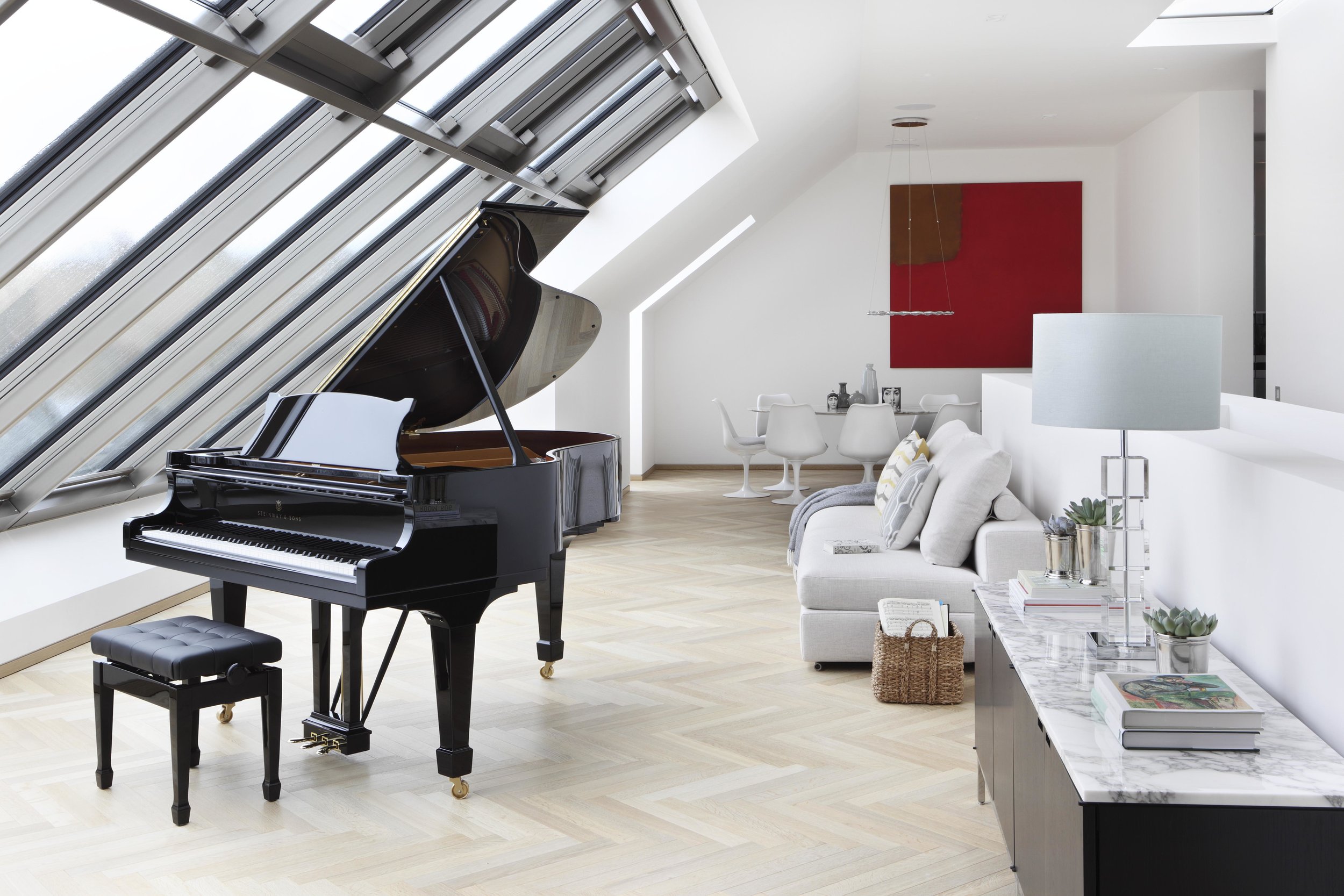
Steinway & Sons: 4 Sustainability Pillars to Piano Making

What makes an honest company experienced in the craftsmanship of a single musical instrument? In the world of sustainable luxury, for Steinway & Sons, 4 base factors are the key — tradition, green issues, transparency and durability. In this world crammed with disposable items in every aspect of life, Steinway & Sons, with more than 160 years expertise in piano making, reassures our confidence in quality, sustained craftsmanship and environmental consideration, and as if by accident, connects with the most talked about emerging trends in the current global luxury sector.

Steinway & Sons, 2016.

Steinway & Sons, 2016.

Transparency and environmental issues are no longer living in an extinct, faraway land only concerning the global fashion superpowers, but are widely prioritised on the consumer awareness agenda, whereas it is a no-brainer luxury brands get more exposure on revealing their behind-the-scenes. With #whomademyclothes increasingly trending on social media as a form of attracting sustainable fashion more visibility, even companies with tradition and history have been affected, due to popular demand, by a new wave of embracing transparency. Yet, what if there is nothing to hide? Steinway & Sons is a company that unintentionally stands in line with the global trend of stripping ‘bare’ in the luxury industry. We may still consider fashion as the most obvious example of an industry aspiring to turn a great degree greener, but also a great deal of craftsmanship and environmental consideration can be put into making a piano — a Steinway piano, made of wood from sustainable sources, can be played and enjoyed for decades, and — coming without an expiry date — even centuries. 

“In today’s marketplace, brands like ours must continue to innovate in order to remain relevant to the world around us, but that doesn't mean that quality and craftsmanship can suffer.”

Steinway & Sons, 2016. 

Steinway & Sons, 2016. 

Steinway belongs to the segment of sustainable luxury products, but understanding the real quality and durability often takes more than just a fancy exterior — it is easy to plaster a product with a luxury label, without making sure the product actually delivers towards the sustainability criteria. At Steinway, in addition to aesthetic appeal of the instrument, the role of actual craftsmanship, skills and the quality of raw materials is taken with utmost importance, where there is no compromise — it takes about a year to make one Steinway piano. In addition, the company boasts only two factories world-wide, based in New York and Hamburg. It takes only a glance under the lid to reveal the complexity of the artisan-built musical instruments measured with great care, assuring the customer that they are not simply paying for ‘luxury’ label, the name.

Steinway & Sons, 2016: Painting of the logo. 

Steinway & Sons, 2016: Painting of the logo. 

Similarly to the flourishing #whomademyclothes trend, the answer to questions like, ‘Who made my piano? How well treated the workers are? Where are they based? How much are they paid?’ , lies in highly-skilled craftspeople and artisans treated fairly and ethically. As a customer, in addition to the basics, like how, where, and by whom the product is made, we shouldn’t discard the most important question — whether the expertise is actually there. Like many other notable luxury corporations, Steinway has chosen to downplay the ostentatious label and opt for a greater degree of transparency — many of their staff have been at its workshops for decades and there are generations of the same family who have dedicated their lives to Steinway. At Steinway, interactive approach is also the key — customers frequently visit the workshops before moving on to the factory’s Selection Room, where they can try out a variety of pianos to find the one that feels right for them.

Steinway & Sons, 2016: Making of. 

Steinway & Sons, 2016: Making of. 

Steinway is also highly dedicated to the exclusivity aspect — any experienced pianist can tell that every Steinway piano sounds slightly different. Over the years, they have introduced a variety of limited editions — the Steinway Crown Jewel Collection is a range of visually striking pianos created from unusual, precious woods that challenges the perception of the ebony high polish concert grand, is typical of this trend. In 2015, in partnership with Wayne Stahnke, Steinway Spirio, the world's finest player piano system, available exclusively on select Steinway grand pianos, was introduced as a remarkable innovation, which is expected to last the full lifetime of the piano. 

Steinway Spirio launch, 2015. 

Steinway Spirio launch, 2015. 

According to the brand's spokesperson, “Since the founding of Steinway & Sons over 160 years ago, innovation and craftsmanship have served as the core tenets of the company. In today’s marketplace, brands like ours must continue to innovate in order to remain relevant to the world around us, but that doesn't mean that quality and craftsmanship can suffer.” Relying on these core principles of sustainability, craftsmanship, tradition and environmental responsibility,  and more than a century worth of expertise, no wonder Steinway is the choice of nine out of ten concert pianists as well as countless professionals and amateurs.

For years on end, Steinway proudly serves as a company that, first and foremost, has its core values in place. 

http://steinway.com


Gudrun & Gudrun — Funky Knitwear Extravaganza from the Faraway Faroe Islands

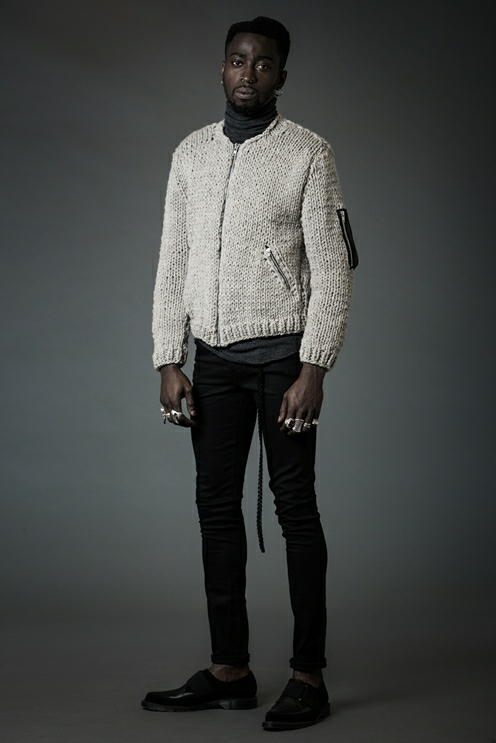
Gudrun & Gudrun, bringing sustainability to life using Faroese wool and traditional knitting techniques, is a fashion-forward knitwear brand gaining momentum with its bold heritage. Emerging from the faraway Faroe Islands, the remoteness of the geographical location inspired Gudrun & Gudrun to use the island’s scarce wool resources wisely, not to let them fade away. Adding a touch of women’s empowerment led thinking and mind-blowing creativity to Gudrun’s journey is what makes the brand as powerful as it stands today. We also never knew knits assembled of natural wool could look so good.

Gudrun & Gudrun AW16/17 Campaign. 

Gudrun & Gudrun AW16/17 Campaign. 

What brought together Gudrun & Gudrun and sustainability?

We didn’t start as some brands might start today, saying ‘we are going to make a sustainable brand’. We just discovered that all the resources on the Faroe Islands [located halfway between Norway and Iceland] were very limited and used poorly. We discovered that we must take very good care of the scarce resources, like in the old days. It’s to do with the heritage of the place, nothing can grow and it is very remote, so we just had to use what the nature has to offer — we have wool, we have sheep and we have fish, that’s all we have here on the Faroe Islands. Sadly, in the rapidly growing economy of the 1990s people didn’t care too much about the natural resources and the local produce, but thought that everything imported from abroad was much more valuable. We came to a situation where most of the wool was burnt and lambskins were destroyed completely, because nobody wanted to use them. Whereas we felt really upset about it, because these were not the values we were brought up with, what we had learnt to do. Then we thought we should put an end to it somehow, sooner rather than later, that’s where it all started… 

Faroe Islands.

Faroe Islands.

So you would say that the isolation of your geographical position, Faroe Islands, closely connects with the story of the brand?

It has a lot to do with being from the Faroe Islands and seeing the natural resources go to waste, seeing that they’re not being used properly. 

 I see more and more brands turning to sustainability. What’s the importance of it, why do we need to move away from the fast-everything culture and mass production?

I think the answer lies in people being more conscious and aware after the financial crisis that really had an effect on their consumption habits. Getting through that crisis, we have learned not to blame the ‘others, or the big ones or the global superpowers’, which were the attitudes flourishing for long, but we have understood that we ourselves are to blame, and we have to take collective responsibility for changing the detrimental patterns. We are all a part of the world, so we all have to play our part in being responsible and making a change. 

Gudrun & Gudrun AW16/17 Campaign.

Gudrun & Gudrun AW16/17 Campaign.

Also, you have a special kidswear range, which many brands have not thought of, or find too difficult to run. How did you come to this idea? It looks so playful… full of colour. 

We started with womenswear only, but often the customers would be like, ‘Awww, I want this type of quality for my child as well’, because we are only using natural materials, and organic yarns, and on top of that, we have the contemporary design and modern thinking. So we have combined everything that has to do with sustainability with the modern, creative side, which is really cherished with kidswear. When it comes to sustainable clothing, I think parents are thinking, first of all, about their babies, who would need the comfort — clothes that don’t do any harm to them. The combination of having the sustainability element and also the design, the aesthetics, is what makes our knits so unique and popular. Kidswear is not found everywhere, but people often look for the quality, the natural materials and longevity, but with that often comes a high price tag, and people refuse to pay for it. Often it is the same price producing a kid's sweater and sweaters for grown-ups, but people are still looking to pay half the price for it. So we have reversed it. 

How does the sustainability aspect come across in the production phase and use of materials?

We always use only natural materials. For example, Faroese wool — the sheep are in the mountains all-year round, they are never kept inside, so they are living on natural, unfertilised grass. The wool is not eco-certified, but just made using common sense and highest quality technology. For it to be the best possible [quality] is more important for us than just having a certificate to say that it is sustainable and organic. In addition to Faroese wool, we also use yarn from a lot of other places — we produce in Peru, using Alpaca wool from Peru, because that also makes sense for us to use the material from the place we produce and we learn a lot of techniques from the Peruvians… then we use organic Merino wool, for example. In addition, we use yarn from a lot of different places, from Italy, Norway, Iceland and Japan. But we always use natural materials, that’s one of our principles. 

"We could not change the fact that the women have a specific role in the family and home, but we could help to empower them by giving them the opportunity to earn their own money."

That must be complex to produce. How big is the workforce?

All in all, we have about 100 knitters, and they are divided more or less equally between Faroe Islands, Jordan and Peru.

Gudrun & Gudrun AW16/17 Campaign. 

Gudrun & Gudrun AW16/17 Campaign. 

There’s also a link between women’s empowerment and your brand… what countries is it related to?

We have a group of women knitting for us in Jordan and Peru. The project in Jordan was started, because before Gudrun & Gudrun I had a completely different career. I was working as a consultant stationed in Jordan, namely as a UE expert, and I always met a lot of ambitious people, and we were talking about the possibility of giving those women a way to earn their own money, because when we are talking about women’s empowerment, we believe that earning your own money is the base of this, the first step. 

"There are a lot of other brands that are so much better at making cheap T-shirts, but it’s not our field of expertise, so it is better that you concentrate on what you are good at, what you truly believe in."

In Jordan, for example, which is a restricted, patriarchal society, for a lot of women, it is difficult to get acknowledged outside the boundaries of their own home, so they are deeply ingrained in the role that they have to take care of the home and their children, there’s no option of having a career. We found that it would be a very good way, if we could fulfil that gap that they too contribute to the society. We could not change the fact that the women have a specific role in the family and home, but we could help to empower them by giving them the opportunity to earn their own money. I have been working with projects a lot and simple projects are often good projects that help to benefit the women the most. Also, for the husbands, it is not a threatening project, because the dinner is still served at the same time and they are still home by the evening, so that structure works for everybody. If it’s a project that the men will oppose, then the women would participate for a few times, and then they would not be allowed anymore, because they cannot take this discussion of freedom at home with them. They meet us in a charity organisation and surprisingly, some women, who started already 8 years ago, are still working with us. 

"Getting through that crisis, we have learned not to blame the ‘others, or the big ones or the global superpowers’, which were the attitudes flourishing for long, but we have understood that we ourselves are to blame, and we have to take collective responsibility for changing the detrimental patterns."

Do you boast a global audience?

We have a very global audience, from Japan to Italy to U.S. We have our flagship store in Faroe Islands and pop-up shop in London at the time, and last year we had pop-ups in Oslo and Copenhagen as well, and then we sell wholesale to a lot of different stores. 

What’s your message, how to give quality production more visibility and reduce the mass-production mania? 

As a first thing, this is what we are good at — we are good at making hand-knit collections. We don’t know any other companies that make full collections in hand-knit, as it's not a machine, it is extremely difficult to execute and control. Quality production from natural materials is something that we have expertise in. There are a lot of other brands that are so much better at making cheap T-shirts, but it’s not our field of expertise, so it is better that you concentrate on what you are good at, what you truly believe in. 

Faroe Islands.

Faroe Islands.

Sustainable Fashion To Die For — Eyglo

Be it the incredulous natural landscapes or modern design, Iceland does not cease to impress us. Reykjavik’s local design store Kiosk, run by 6 designers and named the best place to buy local fashion by The Reykjavik Grapevineun, makes a wonderful hub, providing the customers with latest fashions. From the Kiosk selection, Eyglo is a brand for a stylish and fun woman, led by designer Eygló Lárusdóttir. Her latest collection called 'Murder She Wrote' caught our eye and we were dying to know more.

Words: Johanna Raudsepp

Eyglo Campaign 2016: Photography by Rafael Pinho.

Eyglo Campaign 2016: Photography by Rafael Pinho.

They say first impressions are everything. How would you describe the woman you design for?

I guess I don’t use anyone as a muse when I design. I basically do whatever I like. There’s a certain playfulness mixed with classics, I guess. My clients are women between 24 and 65. [They are] cool, classy and fun. I’d say it’s for women who like to experiment with something fun, but well-made at the same time. 

You like using bold patterns, sharp cuts and pops of colour. What was the inspiration behind your latest collection ‘Murder She Wrote’? 

The inspiration for my last collection was triggered by the series “Murder She Wrote”. I used to watch these kinds of TV series when I was a kid, so Jessica Fletcher certainly has a special place in my heart. It’s kind of strange to come from a place with almost zero crime rate and create a crime-themed collection. I feel that people from the U.S. can relate more to it in a funny way than us, Icelanders, do. 

Eyglo: Jessica Fletcher Jacket, 2016. 

Eyglo: Jessica Fletcher Jacket, 2016. 

I’m into different ways of doing textile these days. I’m doing knitwear with patterns of victims on it — I laser-cut the images and peel the upper layer off, so it gives a 3D-effect, and I also use digital printing. I used to hate orange, but now it’s my favourite colour in the collections. I named one dress after the prison in Iceland, and another one is called Orange Is The New Black, Investigator, etc. 

At Savant, we believe in sustainable living, which is applied to the fashion we feature as well. How do you feel about the issue that people often buy what they don’t need? Is there anything you do as a designer that could alter people’s perspective?

I think people should certainly be more aware of what they’re buying. I do understand people that buy their basics from these big chain stores, like H&M or Zara, but I cannot comprehend how it can be fun to wear any of the other stuff they make. It’s made in such huge quantities that you will become tired of it immediately. The same goes for IKEA. They might make nice items, but you get fed up with them within a few months. At least that’s how my brain works.

"It’s kind of strange to come from a place with almost zero crime rate and create a crime-themed collection. I feel that people from the U.S. can relate more to it in a funny way than us, Icelanders, do."

As a designer, I try to be aware of how I do things as well. Most of my fabrics come from Europe and the garments are made in Europe (Estonia, Lithuania, some in Iceland). I’m looking into attending a sustainable fabric fair early next year, as it can be very difficult to source fabrics when you live in Iceland. 

I have a store called Kiosk in Reykjavik that I run with 6 other designers. We split the rent and the shifts, help each other with contacts and give advice. Kiosk has been named the 'Best place to buy local fashion' by The Reykjavik Grapevine for all of the 6 years we have had the store. We have been recommended by The New York Times, Vogue, Glamour, and many more. All this contributes to altering people’s perspectives in the long run. 

Eyglo at Kiosk, Reykjavík.

Eyglo at Kiosk, Reykjavík.

We recently interviewed Milla Snorrason, one of your fellow designers from Kiosk. It comes to show what a positive impact such a concept store can have — everything fresh and IN can be found in one place. What made you create the store 6 years ago?

One of my friends came up with the idea shortly after the financial crash. We had finished art school few years earlier and wanted to give it a try. We teamed up with about 6 other designers — now it has been 6 years and it has grown so beautifully. I would love to see similar shops like ours in more cities around the world. We have been super lucky with the rent so far, but we are losing our space soon. The plus side of the tourist boom here is that we can sell more, but the downside is that the rent has gone seriously high. At the moment we are actually looking for another space, possibly bigger to add more designers in. So there are definitely exciting times ahead. We also have a pop-up shop in Copenhagen coming up and another one in Laforet, Tokyo, at the end of November.

Eyglo Campaign 2016. . 

Eyglo Campaign 2016. . 

Finally, who do you look up to as a designer? What kind of design makes you swoon?

I do look up to Vivienne Westwood for everything she has said about sustainability. Just buy less and better. Take care of your clothes. Design-wise I´ve always loved Bernhard Willhelm, Christopher Kane and Mary Karantzou, to mention a few.

http://www.eyglocollection.com

#WeAreTesting: Artisanal Apothecary by Evolve Beauty

Artisanal producer of green cosmetics, Evolve Beauty from Hertfordshire, UK, shares their expertise on the benefits of hand-crafted, natural beauty blends. Their organic apothecary range so far consists of facial, body and hair products. All their products are vegan, cruelty-free and produced in small batches, to ensure the freshness of superfood based ingredients. 

Hyaluronic Serum 200, Evolve Beauty UK. 

Hyaluronic Serum 200, Evolve Beauty UK. 

Savant tested their most popular products — Hyaluronic Serum 200 and Daily Renew Facial Cream with Argan oil for a week. The delicate pomegranate-infused serum with rose petal scent gave our skin a nice healthy glow and repaired the skin’s uneven surfaces when applied overnight. The Daily Renew cream, scented with delicate coconut aroma, offers 24-hour protection against irritation and is perfect for preparing the skin for winter, when it is more receptive to dryness and eczema.

What are the benefits of organic facial oils and serums?

Using Organic skincare is highly recommended. Not only are organic products better for the environment, containing no nasty ingredients or synthetic fragrances, but they are more earth-friendly and truly repairing your skin texture. Synthetic ingredients can cause irritation and, ultimately, ageing of the skin (inflamm-ageing). 

What's the most popular product out of your own range?

Our most popular facial product is the Hyaluronic Serum 200. It contains 200mg of low molecular weight Hyaluronic Acid which has the ability to retain 1000 times its weight in water. It also contains Organic Pomegranate extract, which softens and protects. It has been delicately fragranced with organic rosewater. 

What could be the reason behind our beauty counters turning more organic and fuss-free? Why do we now care about what we put on our faces as much as we care about what goes into our bodies? 

Same as above really — fuss-free cosmetics give therapeutic and more effective results. Customers are becoming more and more aware of the effect of synthetic ingredients in they beauty products and are therefore turning to organic en masse…

"Plants that survive in very harsh environments have developed special coping mechanisms — think about the rainforest, where it’s very hot and humid… perfect place for bacteria to grow! Some rainforest plants have the ability to fight off bacteria when applied to the skin."

Name your other organic go-to products and brands that deserve a shoutout. 

This is slightly biased, but I’ll say S5 Skincare! S5 is a range of organic cosmeceutical products based on ingredients sourced from the 5 most extreme ecosystems. Plants that survive in very harsh environments have developed special coping mechanisms — think about the rainforest, where it’s very hot and humid… perfect place for bacteria to grow! Some rainforest plants have the ability to fight off bacteria when applied to the skin. Fascinating!

Besides beauty, what other  'green lifestyle' principles are represented in your everyday life?

100% organic food! Also, cleansing products that are as natural as possible.

Daily Renew Facial Cream, Evolve Beauty UK. 

Daily Renew Facial Cream, Evolve Beauty UK. 

How did you do the testing and find out which combinations would actually work together? 

We work in very close collaboration with our ingredient suppliers, who advise us on formulation. Our little lab is also excellent at coming up with trump formulations! We are also running customer surveys to ask our customers, what they feel is missing from the range, and what they would like to see launched. 

Who is the target audience for green beauty?

Anyone and everyone. I see more people, who were accustomed to using only conventional skincare, now slowly turning to natural and organic, so we see everyone as a potential customer.

The beauty of the healing effect of organic beauty is that, in order to see the difference, you need to religiously apply the products every day, but after noticing the visible, lasting results that help us feel good in our own skin, this becomes a second nature.

http://www.evolvebeauty.co.uk

COS x Agnes Martin at the Guggenheim

To celebrate their support of Agnes Martin at the Guggenheim Museum in New York, COS have created a limited-edition capsule collection.

COS x Agnes Martin Capsule Collection, 2016. 

COS x Agnes Martin Capsule Collection, 2016. 

The collection features 12 items for women and men, inspired by the minimalist and abstract expressionist artist’s work. Well, we can’t think of a better collaboration. Martin’s soft palette and refined details correspond perfectly with the COS brand, who are well known for their minimal aesthetic.

COS x Agnes Martin Capsule Collection, 2016.

COS x Agnes Martin Capsule Collection, 2016.

“Artwork is a representation of our devotion to life.”

- Agnes Martin

The collection is reminiscent of Martin’s light colour wash canvases as well as the loose fit workwear she wore when in the studio. Just like in her work, the new COS collection is soothing and meditative, with subtle design details and interesting prints. We love the waffle knit jumper (softer than soft) and the folded wrap over skirt. The latter of which we can image Martin wearing at dusk in her studio in New Mexico. 

Agnes Martin. 

Agnes Martin. 

COS x Agnes Martin – On display at the Guggenheim New York and available in selected London stores and online now.

Read more about Agnes Martin here >> 

Icelandic Designer Milla Snorrason's Take on Environmental Kindness

Hailing from Iceland, Milla Snorrason mixes unique woollen pieces with a touch of comfort. By creating sustainable fashion for a strong individual, for Milla Snorrason, quality and longevity are the key. We were so inspired by the Scandinavian simplicity and femininity of the Reykjavík-based label that we asked the head designer Hilda Gunnarsdóttir about her design process and her passion for environmental kindness. 

Words: Johanna Raudsepp

Milla Snorrason Campaign 2016.

Milla Snorrason Campaign 2016.

At Savant, we believe in sustainable fashion and the complete traceability of production. Fast fashion is a craze, but it could be slowed down. What is your take on this?

The mass production of garments is a big problem nowadays. I always think our biggest restriction as regular consumers is our purse, but this needs to be perceived as power. Don't buy fast fashion products, as simple as that. Instead, do your research and try to buy from a company that cares about the conditions in the factories it does business with. It’s always going to be more expensive, but it was also never actually supposed to be cheap, [because it is fair and ethical]. I try to apply this philosophy to my production as well. 

Milla Snorrason Campaign 2016: Sóley Sigurþórs by Rut Sigurðardóttir / Stylist: Anna Clausen / Hair and make-up: Fríða María Harðardóttir.

Milla Snorrason Campaign 2016: Sóley Sigurþórs by Rut Sigurðardóttir / Stylist: Anna Clausen / Hair and make-up: Fríða María Harðardóttir.

We love that you like using sustainable materials and wool. Where do you source your fabrics from? What is your favourite material to work with and why?

I love working with Icelandic wool the most, because it is a local product and I can easily visit its producers, which I always do. This inspired me to even start my range of woollen sweaters. I can see and judge with my own eyes, how the sheep are treated and also how the knitting factory's workers are treated. Icelandic sheep get to run around wild all summer, but in the winter it gets too cold, so they’re kept inside. However, I haven't yet reached that goal of using only sustainable materials. Milla Snorrason is still a very small company and, more often than not, sustainable fabrics have too high minimum orders for us. But I am doing a lot of research and taking one step at a time towards more emphasis on sustainability.

Milla Snorrason Campaign 2016.

Milla Snorrason Campaign 2016.

In Iceland, it’s difficult not to be inspired by the magical nature, the breathtaking scenery. Where do you draw your inspiration from when creating a collection for Milla Snorrason? Who is the woman you design for?

For every collection, I take a trip to explore more of Iceland. My favourite pastime is hiking. I take loads of photos and I mostly use these photos to create my prints. Iceland's nature is definitely what inspires me the most, but I also look at so many other things. Our surrounding visual culture inspires me a lot — I go to galleries, watch movies, I surf on the web and I take so many photos and collect them from everywhere. I am constantly researching my next collection. This spring I also went to Mexico and Cuba, which will definitely have its impact in a future collection. 

“I am always inspired by people who treat animals with the same kindness as they do people. She is also a big advocate for environmental issues, which is something I take to heart, when deciding where and how to produce my clothes.”

I design first and foremost for myself, but also for my friends, my mother, her friends and any woman in the street who I think is inspiring, and I always wonder what I'd like to see her wear…

We all have people we admire, be it for their kindness, sense of style, or their lifestyle. Who do you look up to as a designer?

She's not really related to design directly, but the first woman that comes to mind is Jane Goodall. I think her work with animals is so beautiful and I am always inspired by people who treat animals with the same kindness as they do people. She is also a big advocate for environmental issues, which is something I take to heart, when deciding where and how to produce my clothes. Visually, I think female artists inspire me the most. They often don't really think about fashion in a traditional way and can have a fresh and interesting take on it.

“Our surrounding visual culture inspires me a lot — I go to galleries, watch movies, I surf on the web and I take so many photos and collect them from everywhere. I am constantly researching my next collection.”

Finally, let’s look through a crystal ball. What does the future hold for Milla Snorrason?

I will show my next collection in early 2017. It will be based on a four-day trip I took with four of my girlfriends to Iceland's highlands in August. It's going to be called Uxatindar [peak in South Iceland] and it's looking wonderful in my head! Past that I just let things flow naturally. My crystal ball doesn't seem to be working that well yet. 

http://millasnorrason.com

LUMI: Uniting Nature + Science in their Tundra Range — #EcoBeauty

Our skin health is something we often take for granted in the approaching winter months. Yet we all want to look and feel forever young, and that takes at least some effort. Instead of turning to quizzical chemical-packed serums and moisturisers, treating your skin with natural, organic beauty products can help to boost your skin’s own glow and enhance that desired, sleek au naturel look. Could Estonian cosmetics brand LUMI be the next innovation in skincare, taking you a step closer to preserving your youth?

Words: Johanna Raudsepp

LUMI: Tundra Range, 2016.

LUMI: Tundra Range, 2016.

I had the glorious opportunity to test out their new product line called Tundra over the past two weeks. Consisting of the AHA-BHA cleansing milk, AHA-BHA moisturising cream and yarrow mist with salicylic acid, LUMI’s Tundra is a complete skincare routine set. Their natural components, like willow, rosemary and hemp seed oil, form a combination that instantly revives your skin. I have never felt so confident in my own skin — during the test weeks, I didn’t reach for make-up even once! 

These all-natural products boast a distinct, aromatic scent — all three products take your senses into the tundra. It reminded me of a mossy forest and I could almost hear a crystal-clear river bubbling away in the background. What’s unique about these products is that the entire range is unisex, suitable for everyday use for both men and women. 

Curious to find out more about the products that have given my skin a healthy glow (and even added a pep to my step), I asked LUMI a bit more about their new Tundra range and the secret of beauty, of course.

You have released your new Tundra line. What inspired this product line? What makes it special?

Our aim was to create products for acne-prone skin, which would rejuvenate and be effective, yet natural at the same time. Research has shown that up to 85% of people have to deal with acne at some stage in their lives — 20% of whom experience this in adulthood as well.

LUMI's Tundra is special because of its carefully picked natural ingredients and a wholesome skincare routine set-up. It restores and renews, and battles inflammation. Naturally we believe that great skin starts from the inside. Nevertheless, your skincare routine should work on different fronts.

"By mixing botanics with safe, lab-made synthetic compounds, we can create a sustainable, environmentally-friendly product. Integrity is also important — the harmony between our body, spirit and senses."

The metallic green design of LUMI's Tundra symbolises development, growth and the path to becoming someone or something better. Just like the permafrost in tundra rivers hinders erosion, the excess keratinisation of the skin hinders its natural processes, creating a good surface for inflammation. Forget about the scrubs and products with different chemicals — natural moisturising products are what the skin actually needs.

LUMI: Tundra Range, 2016.

LUMI: Tundra Range, 2016.

At Savant, we believe that slow lifestyle with all its nuances will slowly but surely find its way to our everyday lives. So much so, that one day people will make educated choices about all their product purchases. How does LUMI envision the future of the world of cosmetics?

We agree – people will definitely be making smarter, more conscious choices about what they buy. We hear more and more about cosmetics that fight skin-stress and pollution. As natural resources aren’t infinite, we think the future will see more sustainable cosmetics. By mixing botanics with safe, lab-made synthetic compounds, we can create a sustainable, environmentally-friendly product. Integrity is also important — the harmony between our body, spirit and senses. 

"The metallic green design of LUMI's Tundra symbolises development, growth and the path to becoming someone or something better."

They say that first impressions are everything. If LUMI passed from us on the street, what would she look like? What is LUMI’s beauty secret?

LUMI is confident and sophisticated. She is an educated person, who has seen life, has good manners, but isn’t naive or stubborn. LUMI shares their knowledge and experiences with their friends, enlightening them with fresh ideas and new trends. LUMI is warm, open-minded, and Nordic in their mindset — modern and minimalist. The secret to her beauty lies in scientifically certified natural products, comprising of carefully picked ingredients, which she would recommend to friends or family any day. LUMI is inspiring, encouraging, motivating and enthusiastic, infecting others with their positivity. She is trendy, but always adds a personal touch to everything, making her unique. 

http://luminordic.com/en/